

E-bikes are becoming more and more popular in the UK and E mountain bikes are no exception. Ideal for mountain bikers who want to cover more ground, want to get the hills out of the way so they can enjoy the downhills or just don’t like, or can’t, manage uphills. With this growing popularity, comes more and more choice (and potentially more and more tough decisions on which would be best for you). In this article, we will attempt to make this choice easier by detailing some of the main styles and differences between the e-mountain bikes and Liv e-bikes available in the UK and then talk about some of our mainstream brands and models, with in depth looks at the main benefits of each. But first we will discuss the different styles and types of electric mountain bikes. For a more general look at the different types of bicycles.

Main Considerations of E Mtb
- Quick Picks
- Best Electric Mountain Bikes by Price
- Quick Decision maker
- Hardtail Electric Mountain bikes
- Full suspension electric mountain bikes
- Suspension
- Battery capacity
- Motor
- Wheel size
- Brands
- Specialized
- Whyte
- Liv
- Giant
- Merida
Quick Picks
Before we dive into all the different electric mountain bikes, we thought we would draw up a short list of the best electric mountain bikes by each category.
- Best Overall – Specialized Turbo Levo Alloy eMTB – £5199
- Top budget hardtail – Liv Lurra E+2 Women’s electric mountain bike worth – £2499
- Full Suspension – Whyte Kado RS eMTB – £4799 (20% off while stock lasts)
- Best Lightweight – Specialized Turbo Levo SL 2 Comp eMTB – £3999 (20% off while stock lasts)
Best Electric Mountain Bikes by Price
In order to help those on a budget, here are some of the best electric mountain bikes bu price. We will look at the best electric mountain bikes under £3000, under £4000, and then over £4000.
Best eMTB under £3000
For the sub-£3000 price point, you will likely find e hardtails mountain bikes. A quality electric full suspension bike will cost you in excess of £3000 cue to the battery, electric motor, front, and rear suspension. Here are some of the sub-£3000 budget bikes options.
- Liv Tempt E+ Sport Women’s Hardtail eMTB – £1699 (32% off)
- Liv Lurra E+ 2 Women’s Hardtail eMTB – £2499 (24% off)
Best eMTB under £4000
At this price point, we will start to see some full suspension bike s available. Here are some of the best available.
- Giant Trance X Advanced E+ EL 3 Full suspension eMTB – £3299 (40% off)
- Whyte Kado S Full suspension eMTB – £3699 (8% off)
- Giant Trance X Advanced E+ Elite 2 Full suspension eMTB – £3899 (40% off)
- Specialized Turbo Levo SL 2 Comp Alloy superlight eMTB – £3999 (20% off)
Best eMTB over £4000
Over £4000 is the price where you start getting higher quality components like your fork, shock, groupset and brakes. You will also see bigger battery capacity at this price point. Here are the top models.
- Whyte Kado S 800 eMTB – £4499
- Specialized Turbo Levo SL 2 Comp eMTB – £4799 (20% off)
- Specialized Turbo Levo 4 Alloy eMTB – £5199
- Specialized Turbo Levo 4 Comp Alloy eMTB – £5999
- Whyte Kado RSX eMTB – £6399 (15% off)
- Specialized Turbo Levo 4 Comp eMTB – £6799
Quick Decision-Making
We cover this later on in the article in more depth but how do you make the decision between hardtail and full suspension, or between a superlight or a full power e bike? Here is our quick decision maker for these exact questions.
Why choose a hardtail eMTB?
There are a couple of good reasons to choose a hardtail eMTB. The first would be to keep the cost down. A good hardtail e bike will cost significantly less than a full suspension bike. The second reason is to hone your skills on the trail. As a hardtail does not have rear suspension, they are less forgiving so your handling and choice of line need to be good. If you are starting on a hardtail, your skills will improve a lot faster.
Why Choose Full Suspension?
Adding rear suspension will make an eMTB much more forgiving and will make riding down trails a lot easier. It will also make it faster. Full suspension are therefore for those that want to be as fast as possible down hill, or for those that want to have fun without having to dedicate too much time to practising lines.
Why Choose a full-power bike?
A full-power eMTB will have a powerful motor and a large battery. The motor will have more oomf for getting uphill and if you like, you will need to use very little effort at all in the highest assistance mode. The larger batteries will give more range so you will get more loops of your favourite trails.
Full-power eMTB’s are for those that want to get up hills using less effort and want long days on the trail. The full power eMTB’s come with some additional weight over the SL versions.
Why Choose SL (Superlight)?
A superlight eMTB will have a less powerful motor and a smaller battery to keep the weight down. This means that uphills will require more effort and the range will not be as long. What you do get with a superlight eMTB is superior handling when riding down trails. The superlight bikes bring the handling closer to what a non-electric mountain bike would offer.
Superlight bikes are for those that want some help on the uphills but also want a bike that handles more like a non-electric eMTB. Less weight is useful for enduro style terrain.
Hardtail Electric Mountain Bikes
Hardtail electric mountain bikes have a front suspension fork but none on the rear. These make for great gravel and cross country style bikes as they climb very efficiently for mountain bikes as there is no excess movement on the rear. Hardtail ebikes are normally cheaper than their full suspension electric bike equivalent also so make for a good entry point. Where you start to see the difference is when you go on more technical and demanding terrain – hardtails are just not as forgiving as there is no travel on the rear to take the sting out of the bumps on the trail.
Perfect if…
You are looking for a very comfortable ride and are expecting to ride on gravel and trails that are not too demanding and technical. Alternatively, buy this if you have excellent mountain bike skills or are looking to increase those skills as there is no better way to advance your mountain biking than on a hardtail.
Full Suspension Electric Bikes
The term “Full suspension” means that these bikes have both front and rear suspension which allows you to go faster downhill due to the rear end smoothing out the rough terrain. If you are taking on the more advanced trail centres or full-on downhill performance, you will most likely need a full suspension electric bike with powerful hydraulic brakes and good quality mountain bike disc brake pads. The downside of these bikes, especially Electric full suspension electric bike, is that they are more expensive than a hardtail due to all the extra technology required and the extra componentry.
Full-sus electric bikes come in a number of different shapes and which one is best will depend on where you intend to ride it. For more cross country bikes, you will likely require less travel (more on this further down) and will ideally look for a more upright front fork as this helps climbing performance and the more towards downhill performance you are looking, you will be going for a more slack geometry as you begin to point the bike downwards more.
Perfect if…
You want to be as fast as possible downhill or are wanting the maximum forgiveness from a mountain bike.
Suspension
Whether full suspension or hardtail, there are a great deal of options when it comes to suspension, travel in particular. As well as travel, you also get more as you invest more in your suspension performance. We have a blog about hardtail vs full suspension – which is right for me?
Travel
The travel of a mountain bike is the amount that the forks or shocks compress when riding or jumping over obstacles. For more cross country MTB riding, you can go as low as 80mm but for pure downhill riding, there are forks that are 200mm+. Usually, the more technical and downhill, the more travel required. The downside of more travel is that these bikes do not climb so well due to all the excess movement. With electric mountain bikes, the efficiency issue isn’t quite so important as you have the motor assistance so with an e-bike you can afford to go for a bit more travel for forgiveness.
What does better suspension get you?
As you invest more in suspension, you are paying for a few more benefits. Higher spec will generally give you a thicker, and therefore stiffer, stanchion which means less lateral movement when cornering for more predictable handling and less fore/aft movement under braking, again, for more predictability when pushing the limits of your bike downhill. As with travel, where you are riding and your riding style will influence your decision as cross country mountain biking will likely not need a super expensive fork as you will not be requiring the extra stiffness a better fork gets you. Likewise, if you are concentrating on the downhill, then a wider and stiffer fork will benefit you greatly.
Aside from the stiffness, a better fork will generally give you more adjustability. Your most basic fork will be two springs which you can lockout. As you spend a bit more you will get an air fork which can be set up for rider weight with compression adjust (how fast or slow the fork/shock compresses) and rebound adjust (how fast or slow the fork/shock rebounds after impact).
For the most advanced forks, you will have low and high speed compression and low and high speed rebound. This is getting a wee bit techy and I don’t want to bore you so please come in to store to discuss if you are interested. But generally these forks are on the super-high end full suspension electric mountain bikes.

Battery Capacity
The size of a battery will determine how much electric assistance you will get out of one charge. Measured in Watt/hours (Wh) with some as low as 320Wh for a ‘super light’ electric mountain bike all the way up to 750Wh for bikes that can manage multiple day riding on a single charge. The trade off with battery capacity is weight. The bigger the range, the heavier the battery (and the overall weight of the bike). Your lightest ‘super light’ eMTB will be in the region of 16kg while the larger battery versions will be, on average, 25kg.
Motor Power Output
E MTB motor output is measured in Newton/metres (Nm) and is a measure of the amount of torque that assists you from the bottom bracket when you pedal. The range of Nm on the bikes we sell will go as low as 35Nm all the way up to 90Nm+. How you decide on which would be right would, again, depend on your intended use – for cross country with not too many steep hills, a lower Nm value would be acceptable but if you are doing steep hills regularly or want to expend as little effort as possible on climbs, then the recommendation is to go for a higher power output. The exception to this is if you are considering lightweight e mountain bikes where the max torque will be between 35-50N/m and as mentioned above, the battery will be smaller too to keep the weight at a minimum.
All the bikes we stock have a mid drive motor. It is very rare to see an eMTB with a hub motor.

Wheel Size
The eternal question – which wheel configuration do I need? It used to be that the standard for mountain bikes was 26″ but these have all but disappeared with 27.5″ (650b) and 29″ being the two choices available for front or rear wheel (or a mix)
27.5″ Wheel front and rear.
In this configuration, this will be the shortest, and therefore, most nimble version of a mountain bike. Great for cornering on technical downhill sections for those that want responsive handling and a bike that is easy to ‘throw about’. The trade-off of these smaller wheels is that you lose out on straight line stability which is why the 29″ standard has come about.
29″ Wheel front and rear
So if you have read the above, it will be fairly obvious what will be said here – 29″ wheels give incredible straight-line stability and speed and the ability to roll over tree roots and bumps is increased so forgiveness is a benefit too. Your trade off (as you’ve probably guessed) is the cornering on the most technical trails. The 29″ set-up is incredibly popular on electric mountain bikes due to the extra weight and most riders appreciate the stability at high speeds. For years, the standard has been either 27.5″ or 29″ – but wait! Isn’t there a way to get the best of both worlds??
Mullet wheel set-up
Such a simple idea but like all the best innovations – simplicity is key. “Why don’t we combine a 29″ front and 27.5″ rear wheel” (thought the cycling industry experts) to give the best of both worlds. So, taking the nimbleness of a 27.5″ and combining this with the stability and smooth rolling of a 29″ front wheel gives you the best of both with many of the top brands deciding that this set-up makes for the best electric mountain bikes. If you’re interested in how it got the name ‘mullet’ it’s because it’s ‘business in the front, party in the back’.
Top bikes by brand
Here, we will have a look at the top brands we sell with an overview of the different bikes available and then dive in to some individual models. Many of these brands offer unisex sizing but there are some men’s bicycle sizing and women’s sizing.
Specialized
Specialized are the brand we stock that offer both ‘superlight’ and full power/heavier version Specialized Electric mountain bicycle. The differences are the maximum motor output and the battery size. For example, the Specialized turbo levo sl range weigh in the region of 16kg with a less powerful motors and smaller batteries but the plus is that lighter electric e mountain bikes will handle better on the downhills while still giving enough of a boost mode to get you up the hill. The Specialized turbo levo on the other hand offer full power motors and large batteries for effortless climbing performance and all day riding. Specialized e bike also produce the Turbo Tero which are their hardtail mountain bikes and are available in different motor powers and battery capacity depending on which model you opt for. The Turbo Tero X is a slightly different take as this is a full suspension electric mountain bike but with the emphasis on gravel and cross country or cycle touring off-road. For something a little more enduro, there is the Specialized Turbo Kenevo SL for a super-lightweight downhill machine.

SPECIALIZED TURBO TERO 4.0 ELECTRIC MOUNTAIN BIKE
The Turbo Tero 4.0 is an electric mountain bike equipped for everyday rides. You can commute on it, go cross country mountain biking on it, load it up and do some bikepacking or turn it into a touring bike for tow paths. This really is an exceptionally versatile hardtail electric mountain bike. With a 70Nm motor for ample help uphill and a 710Wh motor, you can ride long days or even multiple days in a row without the need to charge your battery. The Turbo Tero comes with a full 29″ wheel set up because of what this bike would be used for – the extra stability would come in very handy when this bike is fully loaded and heading over yonder hills. Finished off with reliable and robust SRAM NX groupset and powerful 4-piston hydraulic brakes for sharp stopping in all conditions and terrain. The Tero model is also available in a 3.0 which costs less for a slightly less powerful motor and smaller battery and the 5.0 which comes with the same battery size but the most powerful motor for effortlessly taking on the steepest inclines.
SPECIALIZED TURBO LEVO SL COMP ALLOY ELECTRIC MOUNTAIN BIKE

The Specialized Turbo levo SL 2 Comp Alloy comes is the superlight version with a carbon frame to aid stiffness and give a comfortable ride when tearing up the trails. Initially set up as a mullet (29″ front wheel and 27.5 rear wheel) but such is the ingenuity of this bike that it can be changed to a full 29er with no extra parts required. An adjustable geometry allows the bottom bracket and head angle to be changed dependent on personal preference. Well specced with Fox 36 Rhythm 160mm travel forks for downhill performance and a Fox Float performance rear shock, there are not many trails that this bike can handle. As mentioned above, the reason this bike is superlight is that the battery is a 320Wh but if you ever feel that this is not enough, Specialized make a battery range extender that fits to a bottle cage that adds 160Wh of battery capacity for when you are doing longer days.
Specialized Turbo Levo Comp Alloy Electric Mountain Bike
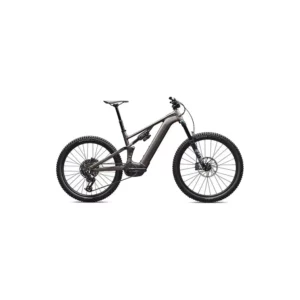
The Turbo Levo Comp Alloy offers effortless climbing on even the steepest of trails and provides excellent handling on the way down. Connect to the app and customise the power supplied by each of the power modes or set up the on board computer to give you 10% increments of power for more fine tuned assistance. Coming with a massive 700Wh battery you will be able to ride farther and the 90Nm motor gives all the oomph you require on any trail. Unlike the SL model, the battery completely comes out of the frame for easier charging.
Whyte
The Whyte Mountain bike range places the powerful Bosch motor and battery lower down in the frame to improve downhill handling. That is why they are thought of as one of the best handling, full-power electric mountain bikes out there.
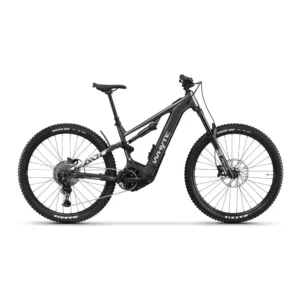
Whyte Kado S V1 Electric MTB
The confidence-inspiring Whyte Kado S 800 delivers high performance at a great price to give you the range, power and capability to realise your riding dreams – without breaking the bank. Kado S is ready to help you push back your riding boundaries – everywhere. Also available in the upgraded Whyte Kado RS and Whyte Kado RSX version.
- Confidence-inspiring handling
- The range to go for miles and miles
- Bosch’s refined and reliable motor
- An easy to remove internal battery
- Game-changing low centre of gravity design
- Meticulously tuned suspension for perfect control
- Specially curated parts, and more
- four piston brakes
Liv
The main selling point of Liv bikes in general is that they are designed by women, for women, and their Electric mountain bikes are no different. These bikes offer excellent value for money as almost all of the frames and components are designed and manufactured ‘in-house’ by Giant in Taiwan. The batteries and motors are designed with Yamaha and can give up to 85Nm of torque.

Liv Tempt E+ Sport Women’s Electric Mountain Bike
Liv Tempt E+ Sport is a hardtail e mtb that can as easily be used for commuting as heading off along fire roads as an off-road bike. Value for money wise it is hard to beat. 70Nm motor for taking on the hills and a 500Wh battery for longer riding between charges. Provided with a coil sprung fork for lock/unlock simplicity and robust and reliable Shimano 9-speed gearing make this an all-round value package
Giant
A very similar story to the Liv bikes – excellent value for money and excellent reliability and power for long days trail riding or bikepacking and touring adventures. There are a number of different styles of Giant e mtb bikes depending on what you will likely be doing on them.
Giant Trance X Advanced Elite E+2 Electric Bike
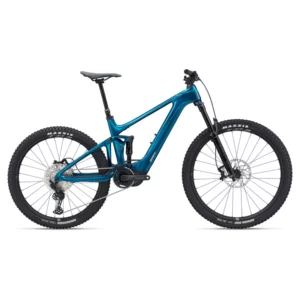
The Trance X range of Giant E mtb is more in the pure cross-country electric MTB category with 150mm front and 140mm rear travel for those who do not need the pure downhill setup of the Giant Reign and being more cross country, it makes sense that this comes with the full 29er setup for that straight-line stability and forgiveness. Again, an 85Nm motor gives excellent assistance up every climb and a 625Wh battery gives the longer range for touring and adventure cycling. As with many modern electric mountain bikes, this bike comes with flip chips to allow the geometry to be slackened or steepened depending on rider preference.
Merida
And last but not least, come Merida. One of the biggest bicycle manufacturers in the world. The e mountain bikes Merida produce come with Shimano motors and batteries for exceptional reliability and smoothness. Available in the eOne-forty for excellent cross country mountain biking or in the eOne-sixty for more enduro riding with more travel and slacker angles for added stability when pointing downhill.
Not ready for an e-MTB? You can find the full range of Merida Mountain bicycles here.

Frequently Asked Questions
Here are some of the most frequently asked questions that the internet has thrown up. Here are our answers.
How much should I spend on an electric mountain bike?
This is a tricky one to answer as for everyone this will be different. When speaking to our customers, we would usually ask their preferences for spec and style and then advise on price after.
For general advice, we would not necessarily say you should focus on a price, but rather that you are looking at eMTB’s that have reputable motor and batteries. Brands such as Bosch, Brose, Shimano, Yamaha, etc. With these brands, you know you are getting quality and will have the backup of warranty in the unlikely event that something does happen.
What is the best electric mountain bikes brand in the UK?
Yeah I don’t think we are going to plumb for one here. All of the brands we choose to stock are excellent and we will put Giant, Liv, Specialized, Merida and Whyte in the mix for the best brand who make some of the best electric mountain bikes in the UK.
Are electric mountain bikes legal on UK trails?
Yes, as long as they comply to the criteria of a EAPC (electrically assisted pedal cycle). This means that the top assisted speed is capped at 15.5mph (25kph), it is pedal assist, and the motor’s contimuous rated power does not exceed 250W. If these criteria are met, the bike is legal for UK trail riding.
How long to eMTB batteries last?
This very much depends on the battery size in Wh (watt/hours). The bigger the battery, the longer the range. to give a rough idea, an 800Wh battery will last approximately 40 to 50 miles. Of course, this does depend on a number of factors such as the assistance mode used on the hills, the hills you are riding, etc.
Can I ride an eMTB in the rain?
Yes, you can ride an eMTB in the rain as the batteries and motors are protected. What they are not protected from is being submerged in water such as streams and small rivers (we have seen this done), and under no circumstances are they to be power washed as the pressure from the water can force its way into the inner componentry (again, we have seen this numerous times).
Do I need insurance for my eMTB?
It is not a legal requirement to have insurance providing that your eMTB fits the criteria for the EAPC (see above). However, we would probably advise that it is worth looking at insurance to protect yourself in case of theft or accidental damage. Especially considering the cost of eMTBs.
Our Stores
You can visit any of our stores to see our range of eMTB or contact our online team if you have any questions. Our stores are located in:
Giant Store Edinburgh (Giant/Liv/Momentum bikes)
Giant Store Stirling (Giant/Liv/Momentum bikes)